Inclusion and Personal Learning Networks in Professional Spaces

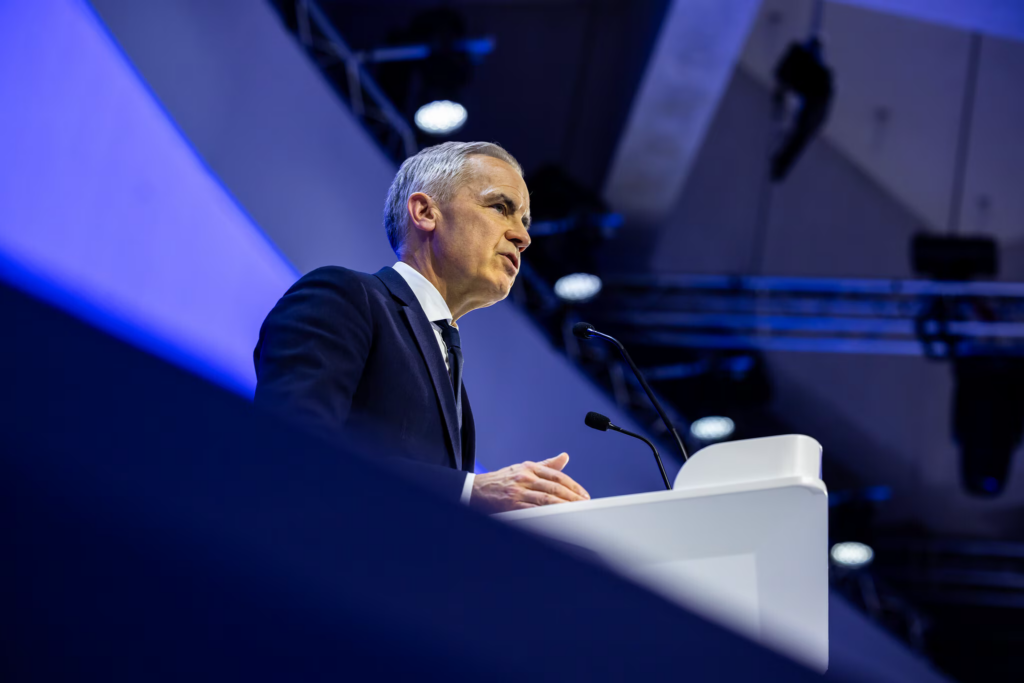
Canadian Prime Minister Mark Carney praised the strengths of the middle powers in his special address at Davos 2026. Image:Ā World Economic Forum / Ciaran McCrickard

This week, I watched the special address by the Canadian Prime Minister, Mark Carney. In this video, the Prime Minister argued that the world is in a ā€œruptureā€ in the rules-based international order that once governed the way nations interacted with one another. Instead of waiting for the old world order to resume, nations (like Canada) should not only be who they are but also with many other nations who share values like human rights, sustainability, and sovereignty.

what resonated with me was the need for many voices and perspectives. National strategy for Canada; it was about recognizing the way nations and regions experience change differently, and the need for collective action to deal with issues.Ā 

Dr. Shelley Moore video – “Inclusion Is Not Assimilation: Understanding Communities of Identity and Diversity”

Another video I Ā watched is the one presented by Shelley Moore, and this made me think more seriously about this issue of inclusion and identity in learning communities. What really made me think is when she emphasized the fact that inclusion is not all about forcing people to assimilate and conform to a particular identity, but it is about creating an environment where all these different identities coexist and are appreciated and not erased. It is not all about bringing all these different kinds of people into one space and calling it inclusion but creating an environment where all different kinds of people feel included without having to change who they are.

Barack Obama video – ā€œObama addresses disinformation in speech at Stanfordā€

In this video, Obama has discussed how social media and search engines have affected our communication with each other. He has stated that they have become the main source of news for most people. Due to this, it has become hard for us to differentiate between what is true and what is false. He has stated that technology companies have a responsibility to be transparent with what they are sharing with people. However, he has also stated that as individuals, we have a role to play as critical thinkers before sharing things online.

What are the benefits of a diverse and inclusive PLN in social media sharing that understands where you are coming from with messaging that impacts the community?

After reflecting on my personal experience with PLN, I have gained a better understanding of the importance of empathy and awareness in online communication. Being exposed to multiple different voices and perspectives has challenged me to think more about my own perspectives and how I communicate them to others. A diverse and inclusive PLN has allowed me to realize that effective communication is not just about sharing, but also about listening. This experience has also reiterated the significance of using social media responsibly and ethically, espeically in a professional setting. Social media can transcend mere surface-level communication and become a place for learning and inclusion if used with purpose.
My Digital Identity and Online Presence

Ā  Digital Identity: Personal vs. ProfessionalĀ 

Personal and professional digital identities serve different purposes. and after researching the distinction is the key to managing how we present ourselves online. My personal digital identity is how I interact with friends and family, definitely more causal vibes. I keep my social media accounts private and list access to close friends and family to maintain security and personal boundaries. which also allows me to be comfortable and in control over who sees my content. Ā In contrast, my professional digital identity is how I present myself as a student and future professional. Platforms like UVIC email, Linkedin, Mattermost, and other academic tools. These spaces are visible to the public, allowing me to have opportunities for networking, career growth, and come across future employers.


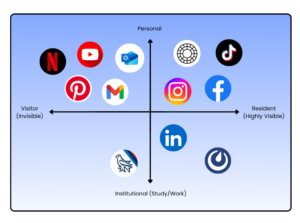
Digital Visitor and Resident MapĀ 

This map helped me visualize how I separate my personal and professional digital spaces, as well as how visible my identity is across different platforms. The personal side of the map shows platforms like Instagram, TikTok, Facebook, and VSCO. These apps being in the second quadrant is for my personal and “resident” end, showing that i’m active and engaged on these platforms. Even though these spaces are more visible, I still maintain control over my privacy through settings, usernames, and restricted access.Ā Streaming platforms like Netflix, YouTube, and Pinterest are on the visitor side, using them for consumption rather than interaction. for me I don’t leave a digital footprint on them they are mainly entertainment focused rather than identity driven.

After reflecting on my map, it made me more aware of how intentional I am with my online presence, even when i’m not actively thinking about it. Seeing the platforms layout in front of me and thinking about what platforms I use definitely helped me recognize that I already practice boundary setting between visibility and privacy. it also made me realize that this map is not forever. Digital identity is not fixed, it changes depending on the priories, responsibilities, and stages of life. For me when it is peak exam season I tend to delete my social media accounts to focus more on school. Making me spend more time on institutional platforms such as Brightspace.Ā 

PLN & Public Communications & Digital Identity

Personalized Learning Networks (PLN)

I personally use a variety of social media platforms to develop my Personal Learning Network (PLN). The platforms I use most frequently are Instagram and TikTok, and I occasionally use Facebook as well. I’ve found Instagram especially helpful for consuming content related to my interests, such as cooking and baking videos, as well as fitness content that helps keep me motivated to stay active and engaged in my hobbies.

On TikTok, I follow influencers and creators who positively influence me. I also have my own profile where I’ve uploaded a few silly videos from the past, which makes the platform feel more personal and fun. TikTok has grown significantly over the past few years, and there are many ways to engage with others, such as following creators, liking and commenting on videos, and saving content that I find useful or inspiring. Facebook surprised me with how often I actually use it when I think about it. I frequently use Facebook Marketplace to browse or sell items I no longer want, which has been very helpful. Beyond that, Facebook also allows me to stay connected with people I know and discover others who share similar academic or personal interests.

All three of these platforms allow me to build connections with others in different ways. Whether it’s adding people I already know or connecting with individuals who share similar interests, these social media apps have helped me expand my PLN and engage with a wider learning community.

Risks and Rewards of Public Communication

I try to be carful with what I post online because I understand the importance of protecting your own personal information and also the type of interactions I am having with others. My social media accounts are private and that allows me to have control over who I want to see my account as social media such as instagram exposes a lot of your day to day life. Things like posting on your page, story, or even things you are tagged in you can get an understanding of who you are. The risks are oversharing personal information, bring misinterpreted on a comment, or even taken out of context. The rewards are allowing yourself to network and connect with people, allowing yourself to engage in conversations and expressing own perspectives and insights. 

Digital Idenity

Understanding the importance of digital Identity is the reason why my instagram is private. Allowing myself to be able to pick and choose who gets to see my instagram and view everything gives me a sense of security and safety. I also believe it’s important to keep my professional and personal life separate. I personally wouldn’t want my employer seeing my instagram, preferably only friends and family. Having a Digital Identity is also the cost of being a student, from when you are admitted to the school you get a personalized V number, a Uvic email, access to brightspace and many other online services. Digital Identity is not bad, but helpful and I believe that couldn’t be a student without one.